


Maxillofacial surgery

Orthognathic surgery is a procedure that aims to correct jaw imbalances in patients with severe malocclusions or facial skeletal abnormalities. These misalignments between the upper jaw (maxilla) and lower jaw (mandible) can cause difficulties with chewing, speaking, breathing, or even significant aesthetic complexes.
It often concerns young patients between the ages of 16 and 35, but may also be considered later in life, depending on the case. This surgery is always preceded and followed by orthodontic treatment, which requires close collaboration between the orthodontist and the maxillofacial surgeon.
-
Facial implants
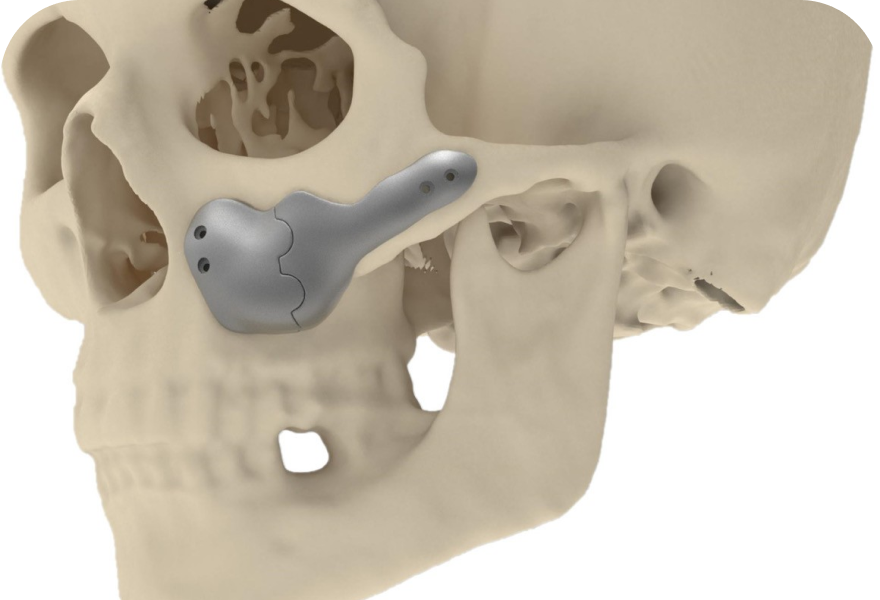
Learn moreFacial implants are a modern surgical solution that can permanently improve facial harmony.
-
Orthognathic surgery
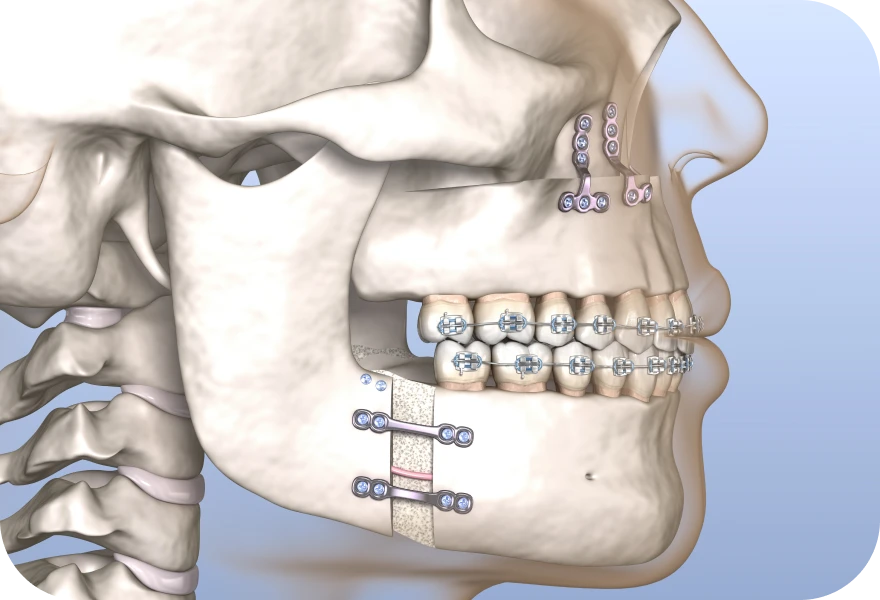
Learn moreOrthognathic surgery is a comprehensive treatment that profoundly transforms patients’ quality of life, both functionally and aesthetically.
-
Facial traumatology
Learn moreWith the right treatment, it is possible to restore facial volume, symmetry and function, while minimizing scarring and after-effects.
Correcting, rebuilding and harmonising the structures of the face
Maxillofacial surgery addresses the anomalies, imbalances and traumas affecting the face, the jaws and the underlying bony structures. It is indicated when facial harmony is impaired and when essential functions are disrupted — chewing, breathing, speech or dental occlusion.
A personalised plan before every treatment
Before any procedure, the maxillofacial surgeon carries out a full assessment. This may include a clinical examination, an analysis of the dental occlusion, medical photographs, X-rays, a facial CT scan or digital planning.
These exams help evaluate facial symmetry, bone projection, the relationship between the jaws and the possible functional consequences. Depending on the case, treatment may be coordinated with other specialists — typically an orthodontist, a dentist, a radiologist or an ophthalmologist.
Jaw surgery to restore the occlusion
Orthognathic surgery corrects significant discrepancies between the upper jaw (maxilla) and the lower jaw (mandible). Such imbalances can cause difficulties with chewing, speech or breathing, and can also alter the profile, the smile or the symmetry of the face.
Main indications
This procedure may be indicated in severe malocclusion or in cases of facial skeletal anomaly. It particularly concerns patients with prognathism (the lower jaw is too far forward), retrognathism (it is too far back), anterior open bite, facial asymmetry or a gummy smile.
It may also be offered when the jaw discrepancy causes joint pain, difficulty chewing or, in some cases, breathing disorders such as sleep apnoea.
A combined orthodontic and surgical treatment
Orthognathic surgery is always combined with orthodontic treatment. A first phase aligns the teeth over their bony bases to prepare the surgical repositioning of the jaws. After the operation, a post-operative orthodontic phase finalises the occlusion and stabilises the result.
Depending on the diagnosis, the procedure may involve the maxilla, the mandible, the chin or several structures at once. The main techniques include upper jaw (Le Fort) osteotomy, mandibular osteotomy and genioplasty. Together, they improve the balance of the profile, lip closure, dental occlusion and overall facial harmony.
Restoring facial volumes with facial implants
Facial implants are designed to improve the contours of the face on a lasting basis by acting directly on the bony framework. They can be used to reinforce a jaw, restore definition to the cheekbones, correct an asymmetry or rebuild volumes lost over time.
Unlike hyaluronic acid injections, which give a temporary result, facial implants offer a long-term stable solution. They are particularly suited to patients with a genuine lack of bony projection or who are looking for a more structural improvement to their facial contours.
Mandibular angle implants
Mandibular angle implants help to better define the lower jaw. They are indicated when the lower face lacks structure, when the jaw appears too narrow, or when the mandibular line is not sufficiently pronounced.
The goal is to achieve a sharper jawline, better symmetry of the lower face and a natural result that suits the patient’s morphology.
Cheekbone implants
Cheekbone implants — also known as malar implants — increase the volume and projection of the mid-face. They can be indicated when the cheekbones are naturally underdeveloped, in cases of asymmetry, or when the face appears hollow.
By restoring facial relief, they help improve the balance between the upper and lower face, support the tissues and provide a more harmonious appearance.
A bespoke approach
Facial implants are usually custom-made — typically in titanium or PEEK — to precisely match the patient’s anatomy. Their shape, volume and position are defined after a detailed analysis of facial proportions. The procedure is most often performed intra-orally — through the inside of the mouth — which avoids visible scars on the skin.
Facial traumatology and management of facial fractures
Facial traumatology covers the management of fractures and injuries of the face following an accident, a fall, a direct impact, an assault, a sports injury or a workplace accident. These injuries may affect a single bony structure or several areas of the facial skeleton.
Warning signs to watch for after a trauma
Certain signs should prompt a prompt consultation: significant swelling, bruising, localised pain, visible deformity, facial asymmetry, nasal bleeding or breathing difficulty.
A change in dental occlusion, difficulty opening the mouth, numbness under the eye or in the chin area, double vision or reduced eye movement can also suggest a fracture. A facial CT scan is often needed to confirm the diagnosis and guide treatment.
Most common fractures
Fractures may involve the nasal bones, the cheekbone, the orbit, the mandible or several structures at once. Each location can produce specific symptoms: breathing difficulty for nasal fractures, occlusion disturbance for the mandible, double vision for the orbit or a flattened cheek in the case of a zygomatic fracture.
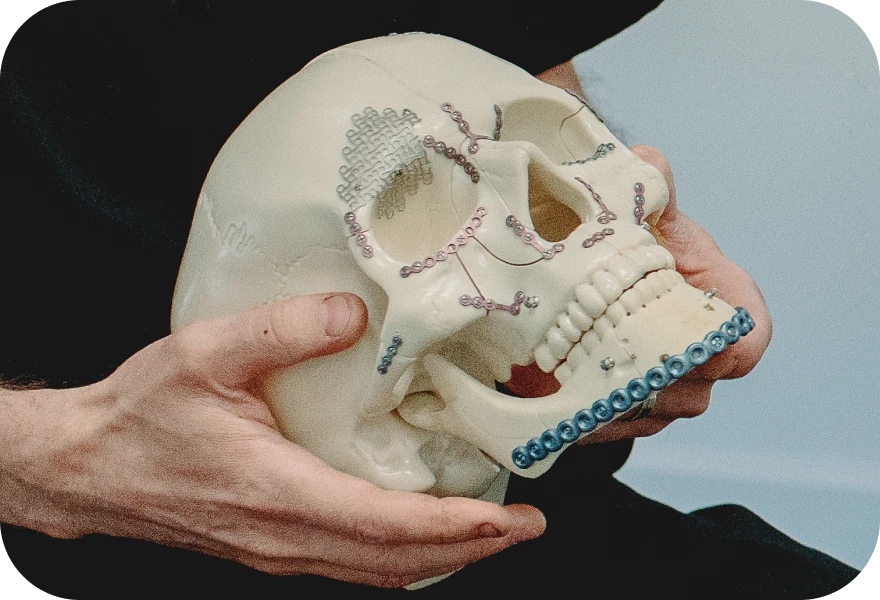
Treatment depends on the type of fracture, its displacement and its functional impact. Some fractures can be monitored, while others require surgery to reposition the bone fragments and stabilise them with plates and screws.
Comprehensive and lasting care
Maxillofacial surgery is grounded in a comprehensive vision of the face. Whether the goal is to correct a jaw discrepancy, reinforce facial contours or treat a fracture, every procedure aims to restore function, symmetry and harmony.
Thanks to modern imaging, planning and reconstruction techniques, treatments can be prepared with precision. This approach delivers natural, stable results tailored to each patient, with attentive care before, during and after the procedure.